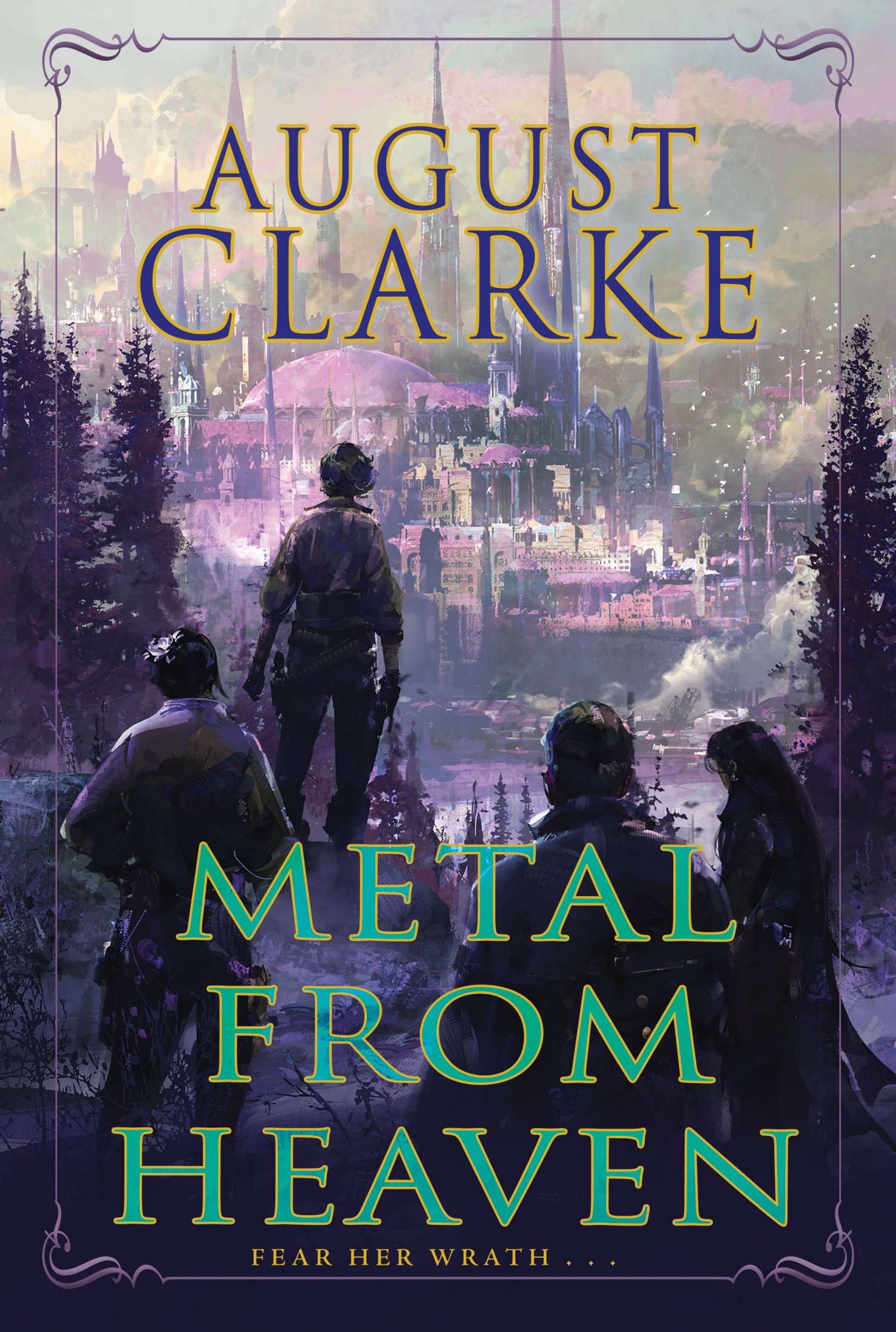
August Clarke’s Metal from Heaven opens like this:
Know I adore you. Look out over the glow. The cities sundered, their machines inverted, mountains split and prairies blazing, that long foreseen Hereafter crowning fast. This calamity is a promise made to you. A prayer to you, and to your shadow which has become my second self, tucked behind my eye and growing in tandem with me, pressing outwards through the pupil, the smarter, truer, almost bursting reason for our wrath. Do not doubt me. Just look. Watch us rise as the sun comes up over the beauty. The future stains the bleakness so pink. When my violence subsides, we will have nothing, and be champions. In the chasms wheat spikes and poppies will grow. Rarely is the future so immediate and tangible. Bless our triumph! How small you seem. How small you were. Remember?
And this is one of the things I liked about it, and one of the things I found so frustrating that I had to scrape out a little time to write it up.
So this is secondary world fantasy set during an industrial revolution. Our narrator, Marney Honeycutt, saw her entire community massacred because they tried to unionize over conditions at the ichorite factory. Ichorite, the titular metal, gives some of the people who handle it seizures and hallucinations. Marney is one of these lustertouched; she, however, is also able to manipulate ichorite, which she discovers when she flees the city and falls in with lesbian communist bandits.
Marney comes to adulthood among the lesbian communist bandits’ community. Her goal in life is to kill the industrialist who ordered the massacre; to get close to him, and also to protect the community, she ends up masquerading as an aristocrat to participate in a competition that the industrialist’s daughter is running to find herself a wife.
(The dating competition, which is basically a reality TV show except without the TV show part, doesn’t start until about 45% in. However, it is in the jacket copy, so I’ve decided it’s not a spoiler and regardless useful to know—partly because I was startled as heck when I came to it. (If I’d read the jacket copy, which I often don’t, I’d forgotten that part.))
Going back to the opening. I love first-person direct address narration, of course, and while the prose isn’t going to be to everyone’s taste, I quite enjoyed it. And the end wraps back around to this opening in a way I found genuinely beautiful.
However, I can only characterize the overall story of the book as, "what if the violent overthrow of capitalism and industrialism ("cities sundered" etc.), except only the bad people die?"
Unfortunately, this does not make sense even within the text of the book: the problems it acknowledges, it handwaves away in single sentences. And it ignores many more.
I admit that I’m allergic to speculative fiction that set up extremely clear analogies to real-world injustices, and then solve those injustices through means that only work because it’s speculative fiction. Here, it was impossible not to think of ichorite as oil throughout most of the book, and then the analogy broke down because it’s fantasy—which it’s allowed to be! There’s nothing intrinsically wrong with that! I just don’t like it.
So my reaction to the overall story is certainly colored by that. And it’s possible that I would be more charitable to the plot holes and handwaving about only the bad people dying if there were fewer overall plot holes and handwaving. There are a lot of things in this book that do not make any sense, and the cumulative effect was ultimately too much for me. Unfortunately, I suspect not.
Besides the prose and the plot, the other thing I noted about this book is that it’s 95% lesbians by volume. Specifically, butch and femme lesbians; the book’s very interested in how that involves gender as well as sexuality. That’s all great. There is a point, however, where a character breaks down gender in a speech that felt like a mouthpiece for the narrative:
“We have five genders recognized within the Splendid Fraternal Federation of the Crimson Archipelago. You have two. Precision becomes difficult.”
Where to even begin. “Five?”
“Mhm. There’s penetrating men, that’s [character], penetrated men, that’s me, the same division for women, and then those for whom penetration isn’t applicable, which is all children, all priests, a fair number of others disinterested for whatever reason. Penetrators are closer in gender to each other than they are to those penetrated and vice versa.”
Regardless of whether this character was actually speaking truth about this world, the remark did underline for me that the book has many lesbians, a few gay men, a handful of heterosexuals; no trans people and no bisexuals. The "about the author" uses they/he pronouns for Clarke, so I think it reasonable to assume that this focus was deliberate, not the result of unfamiliarity with the spectrum of human gender and sexuality. And like with the fantasy nature of ichorite, this is a thing a book is allowed to do! However, as a queer woman, I was not expecting to feel so alienated from a book so intensely focused on queer women.
(Edit: it’s been pointed out to me that there’s a strong possibility that one character is bisexual.)
(Also, in the aftermath of a fantasy Roman-or-Etruscan Empire, there are only white people. A single character has a "brown" face; she is from a "far-off" country "across the water.")
Finally, this book feel so emphatically post-Broken Earth trilogy that I was shocked not to see it in the acknowledgments; and further shocked that I couldn’t think of other works that were similarly post-Broken Earth. Suggestions welcomed! (I was also surprised that it’s been so long since Harrow the Ninth came out that it could appear in the acknowledgments of a book published last year. The inexorable linear progress of time, sigh.)