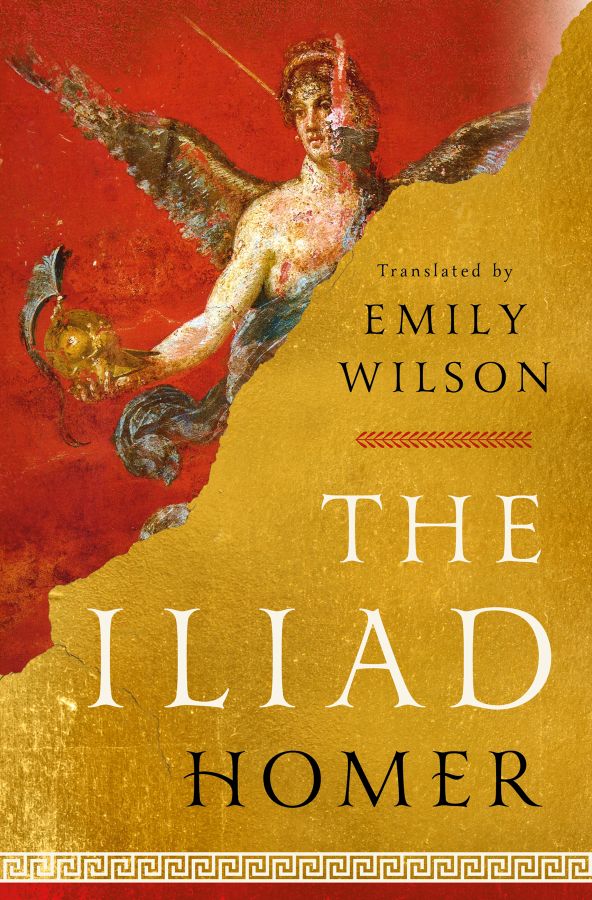
At Readercon I was also on a panel about The Odyssey in 2026 (this was the week before the Nolan movie). I’d read Emily Wilson’s translation a little while ago, but figured I’d better reread it, but first reread The Iliad, which I had last read in college. Happily, Wilson had also put out a translation—and even more happily, its audiobook is narrated by Audra McDonald.
Wilson notes that The Iliad hasn’t had the same historical cultural prominence as The Aeneid; I suspect this is also true with regard to The Odyssey, though she doesn’t make that specific comparison. It’s not hard to see why. It’s very tightly focused, so there isn’t the same layered narrative with lots of adventures; the moral and ethical distance between the present and the past is foregrounded from the very beginning; there’s quite a lot of repetition (including word-for-word verbal messages in close succession; from a modern point of view, the one time when the message isn’t word-for-word doesn’t seem sufficient payoff); and it’s really startlingly violent. The battle scenes are generally, here are a few lines about this guy’s background, and now he’s going to be killed in a very specific and embodied way that is frequently visceral in both the literal and figurative sense; on to the next guy, lather rinse repeat. There is no question about the cost of war to the direct combatants: they are all individuals, and their bodies are all violated in horrible ways. (It helped a lot that I was listening to an audiobook while I was doing other things, like gardening.) However, while the cost of war to those not directly in combat is foundational to the plot, the poem isn’t interested in that.
What the poem is interested in, is the tragedy of Achilles. And because of the way that ties into the difficult stuff above, it’s perfectly understandable to look at him and say, I’m not here for this. I wasn’t exactly there for that on an emotional level, but I did appreciate on a craft level how everything fits together (aided, I strongly suspect, by Wilson’s efforts in both the text and the accompanying material at making it legible). I don’t know that I find it as interesting as The Odyssey, but I’m glad I went back to it.
Wilson’s translation is iambic pentameter but not line-by-line, and thus avoids the compression inherent in her Odyssey translation. It also has great endnotes. Because I was on a bit of a deadline to get to The Odyssey, I did not do a lot of cross-comparing with other editions.
Finally, Wilson’s introduction is very interesting and thoughtful, as I expected having read her Odyssey translation first, and it ends with an even more remarkable paragraph than that one:
You already know the story. You will die. Everyone you love will also die. You will lose them forever. You will be sad and angry. You will weep. You will bargain. You will make demands. You will beg. You will pray. It will make no difference. Nothing you can do will bring them back. You know this. Your knowing changes nothing. This poem will make you understand this unfathomable truth again and again, as if for the very first time.
Dang.
Turning to The Odyssey—
I read Wilson’s translation first in 2025. It had been on my mind for a while because SteelyKid had been very into Epic: The Musical, which I found remarkably different from its source. (I found it fun to tell people familiar with the poem that the second song is Odysseus angsting over killing Hector and Andromache’s infant son, in which he repeatedly says "I’m just a man.") I found Wilson’s translation extremely readable, and I also wondered if I’d read the whole thing in college after all, because there was so much that was different from both its popular reputation and my vague impressions. The monster set-pieces are so short, and the time after the return to Ithaca so long; it opens in media res and stays away from Odysseus for four whole books; and it is deeply ambivalent about whether Odysseus is acting correctly.
When I went back to it for Readercon prep, I’d meant to listen to a newer translation, by Daniel Mendelsohn, for the contrast. Unfortunately he reads the audiobook himself, and I am incredibly picky about audiobook narrators. So I listened to Claire Danes read the Wilson translation and read along with Mendelsohn, at least until about halfway through, when I ran out of time and had to finish listening to Wilson on the way to, and indeed at, the con.
Wilson’s translation, as I mentioned above, is line-by-line iambic pentameter, which, as Mendelsohn points out in his introduction, necessarily involves compression since the original Greek is a longer line. Mendelsohn’s is thus line-by-line in a six-beat meter. Putting aside questions of meter and poetic flow, since I simply cannot hear meter and thus cannot form an aesthetic preference between the two—there are occasions when I felt that Wilson’s shorter lines introduced some ambiguity or lost something. But there weren’t that many, at least in the first half that I was doing direct comparisons on.
And while Mendelsohn has much more useful endnotes [*], he is very weird about Helen in a way that means I simply do not trust him. In his introduction, he says that in Book 4 she "is as seductive and manipulative as ever." Excuse me? I mean, first of all, there is no such thing as a consistent portrait of Helen in the sources. To have formed a definite opinion about her character is therefore certainly a choice. Second, what, exactly, does she do in Book 4 that is seductive?!? (I’m going to pass over his comments about her in the endnotes because I do have other things to be doing tonight.) But more importantly, Wilson very carefully and thoroughly explains why she thinks Helen calling her face "doglike" should not be translated as Helen calling herself a "bitch." I don’t need Mendelsohn to agree with that, but I do at least think that he ought to at least address why his Helen still calls herself "a shameless bitch"—a phrase I found genuinely jarring. He does not, not even in an endnote.
[*] Amusingly, Wilson is doing another translation, still in iambic pentameter but not line-by-line and also with, as she said on Instant Classics’ book club, "quadruple the endnotes."
I have two other translations. Robert Fagles is what Chad had recently read. I read his introduction (a lot about the historical understandings of the origin of the text) and then found a preview of Ian McKellen’s reading of the audiobook. Unfortunately, Fagles has Zeus recount how they warned Aegisthus against killing Agamemnon thusly:
Far in advance we told him so ourselves,
dispatching the guide, the giant-killer Hermes.
‘Don’t murder the man,’ he said, ‘don’t court his wife.’
Which is when I reflexively hit "pause," because not even Ian McKellen could make me believe that.
And I did not read any of Peter Green’s translation because he has the oddest preoccupations. According to his introduction, "what must put the heaviest strain on the modern reader’s willing suspension of disbelief is Athēnē’s preternatural, instantaneous ability to transform Odysseus’ physical appearance." Yes. That is definitely the most difficult thing to believe in this story. And he’s really mad about the length of time that Odysseus and Menelaus are away from their homes, saying that the only reason is to let the next generation grow up enough to participate in the plot. I mean, correct? I’m sorry that that the timelines in earlier documents wouldn’t have accommodated the story that the poet wanted to tell?
I am, I admit, indebted to Green’s introduction for two things. First, he is the only one of the four to mention Agamemnon’s willingness to sacrifice his daughter as a reason that Clytemnestra would want to kill him—something I had been wondering about all through the endless reiterations of the cautionary tale of his death. Because Green’s the only one of the four, I was dubious about his accuracy, but it does seem to be the case that it was a known story at the time. The fact that Homer leaves that out is therefore really good to know. Second, Green refers to Athena’s function in the plot as "micromanagement," which is both funny and accurate, and which I thought of often while I was reading.
Anyway, though I can’t exactly recommend reading The Iliad, I do recommend The Odyssey, because it’s got a lot more in it and it’s fascinatingly unlike the way it’s thought of in popular culture (as is often the case with classics, of course). And ultimately the best translation is the one you enjoy reading. (But read Wilson.)